
Today’s Leader of Faith
HENRY McNEAL TURNER
Home Call : 08 May 1915
Bishop, Preacher, Politician, Advocate, Activist
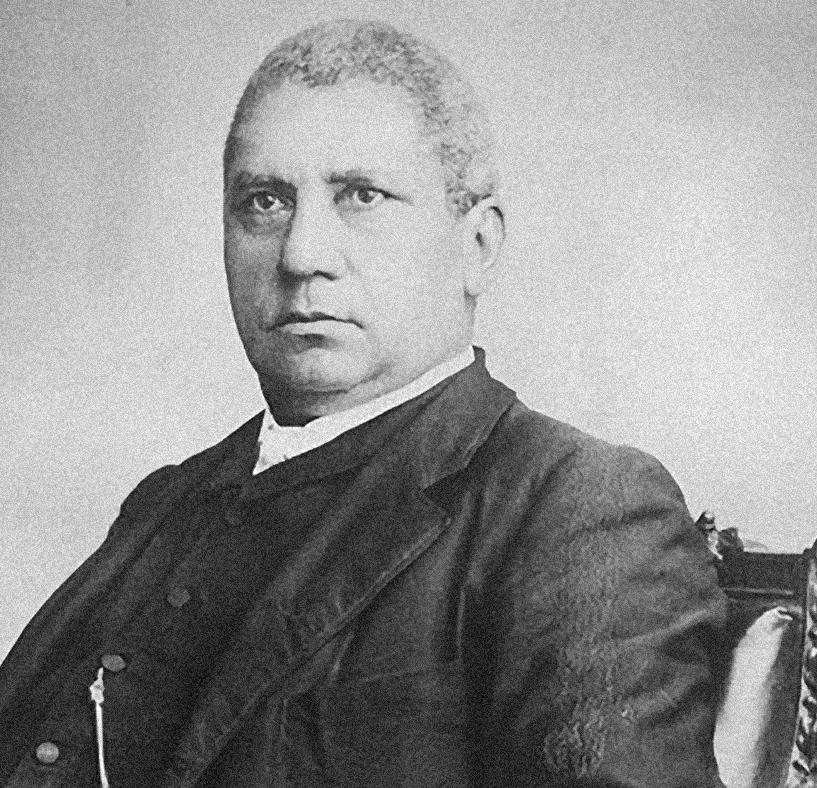
Henry McNeal Turner (1834–1915) was a pioneering African American bishop in the African Methodist Episcopal (AME) Church, a prominent civil rights leader, and one of the first Black men elected to the Georgia State Legislature during the Reconstruction era (after the Civil war). He was born free on February 1, 1834, in South Carolina to parents of mixed African-European ancestry. He was raised by his mother and grandmother. Despite laws banning the education of African Americans, he escaped cotton field labor and found work at a law firm in Abbeville. At age 14, he was inspired by a Methodist revival and vowed to become a pastor. He received his preacher’s license at 19 in 1853 from the Methodist Church South. As an evangelist, he travelled the South before moving in 1858 to St. Louis with his young family, fearing the threat of kidnapping and enslavement under the Fugitive Slave Law of 1850. There, he was ordained in the African Methodist Episcopal (AME) Church and studied classics, Hebrew, and divinity at Trinity College. He later pastored in Baltimore and Washington, D.C., where he met key Republican figures. In April 1862, during the Civil War, he was appointed to Israel Bethel Church, the largest AME church in Washington, attracting both congressmen and army officers.
Turner was a key African-American leader during and after the American Civil War. He organized and served as chaplain for the 1st United States Coloured Troops, preaching to black soldiers and emphasizing that their faith, courage, and loyalty were vital to the destiny of their race. Despite illness, he served in several battles and helped oversee freedmen settlements. After the war, he focused on politics, joining the Republican Party and being elected to the Georgia Legislature, though he and other black law makers were initially denied their seats. He also served as Macon’s postmaster but became disillusioned with increasing racial discrimination and the erosion of civil rights. Turner strongly criticized the 1883 Supreme Court ruling that weakened protections for blacks and later promoted black nationalism and emigration to Africa, founding the International Migration Society which organized African American emigration to Liberia.
Turner gained fame as a powerful preacher, traveling widely to evangelize among both freed blacks and formerly enslaved people in the South after the Civil War. In the African Methodist Episcopal (AME) Church, he became a powerful leader, founding numerous congregations in the South, dramatically growing the church’s membership. He was elected bishop in 1880, the first from the South, and supported causes like women’s ordination (briefly), prohibition, and women’s suffrage. He expanded AME missions into Africa, organized church conferences there, and encouraged black students from South Africa to study in the U.S. Though his emigration advocacy was divisive, Turner remained a respected churchman and racial leader, building unity across denominations and the broader African-American community. He promoted independence from white-dominated churches, empowering black Christians to lead their own faith communities. He also encouraged African Americans to see Africa as a spiritual and ancestral homeland, blending missionary work with Pan-African vision.
Turner died on May 8, 1915 at the age of 81, in Windsor, Ontario, Canada, at the age of 81. He had gone there for health reasons, but his health continued to decline. His body was returned to the United States, and he was buried in Atlanta, Georgia.
— John Michael, Rajahmundry