
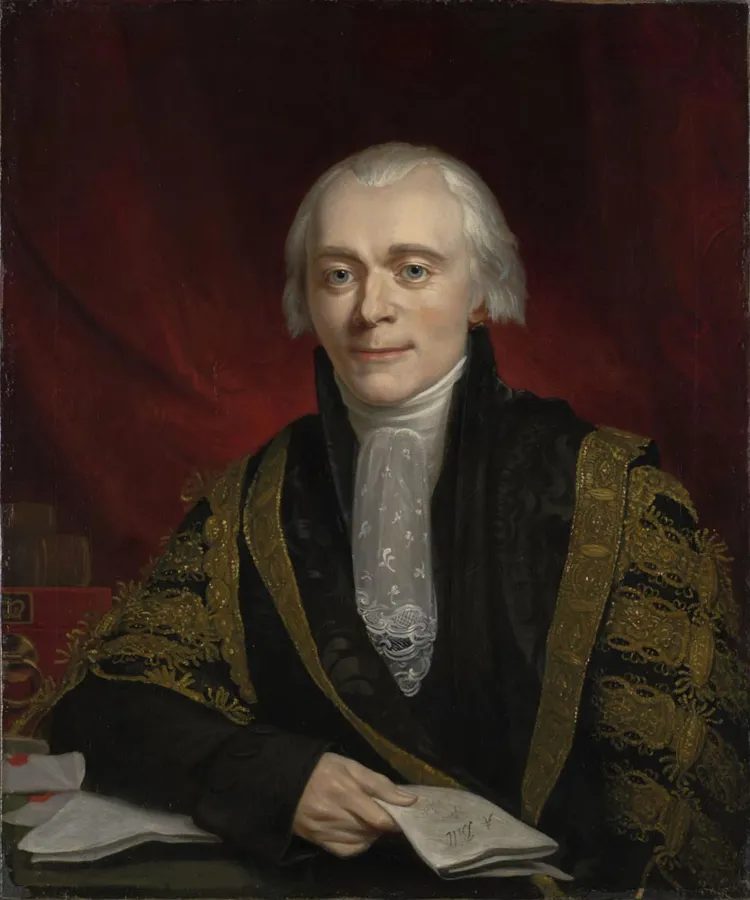
Today’s Leader of Faith
ZACHARY MACAULAY
Home Call : 13 May 1838
Scottish Abolitionist, Statistician, Secretary of the African Institution, Editor
Zachary Macaulay (1768–1838) was a prominent Scottish abolitionist, statistician, and colonial governor, renowned for his pivotal role in the movement to abolish slavery within the British Empire. He was a devout Christian reformer and leading abolitionist whose life was marked by unwavering commitment to applying the principles of the Gospel to the social evils of his time. He was born on May 2, 1768, in Inveraray, Scotland, to Margaret Campbell and Rev. John Macaulay (1720–1789), a minister of the Church of Scotland and a descendant of the Highland chief Dòmhnall Cam. Raised in a devout Christian household, Macaulay was shaped by the strong moral and spiritual values of his father’s ministry. Among his siblings were Aulay Macaulay, an antiquary, and Colin Macaulay, a British general and fellow Christian abolitionist. Though he did not pursue formal higher education, he was intellectually self-motivated. He worked in a merchant’s office in Glasgow, where he fell into bad company and began to indulge in excessive drinking. In late 1784, when aged 16, he emigrated to Jamaica. There, he worked as an assistant manager at a sugar plantation. However, he objected to slavery, contrary to the preference of his father, and renounced his job. He returned, in 1789, to London, where he reduced his alcoholism and became a bookkeeper.
Macaulay’s life took a decisive turn under the influence of Thomas Babington of Rothley Temple, an evangelical Whig and committed abolitionist, who was also his brother-in-law. Through Babington, Macaulay was introduced to key Christian reformers, including William Wilberforce and Henry Thornton, leaders of the Clapham Sect, a group of evangelical Anglicans whose faith compelled them to pursue social justice. In 1790, he visited Sierra Leone, a West African colony established for freed slaves. He returned in 1792 to serve on its Council and was appointed Governor in 1794, serving until 1799. On his return to England, he became a prominent member of the Society for the Abolition of the Slave Trade, working alongside Wilberforce to end slavery throughout the British Empire. He later served as Secretary of the African Institution and edited the evangelical magazine The Christian Observer from 1802 to 1816. As an active member of the Clapham Sect, he brought his Christian convictions into public life, serving on committees that helped found London University, the Society for the Suppression of Vice, and supporting the British and Foreign Bible Society, the Church Missionary Society, and the Cheap Repository Tracts. In 1823, Macaulay helped found the Society for the Mitigation and Gradual Abolition of Slavery, becoming editor of its journal, the Anti-Slavery Reporter, through which he exposed the injustices of slavery and criticized pro-slavery justifications. Though he advocated for a free Black peasantry rather than full racial equality, his tireless work was deeply grounded in Christian moral conviction and a desire to uplift the oppressed in the light of the Gospel.
Zachary Macaulay died on May 13, 1838, in London, at the age of 70. He was laid to rest in St. George’s Gardens, Bloomsbury. His son Thomas Babington Macaulay carried forward his legacy of intellectual achievement and public service as a Historian and Statesman.
— John Michael, Rajahmundry