
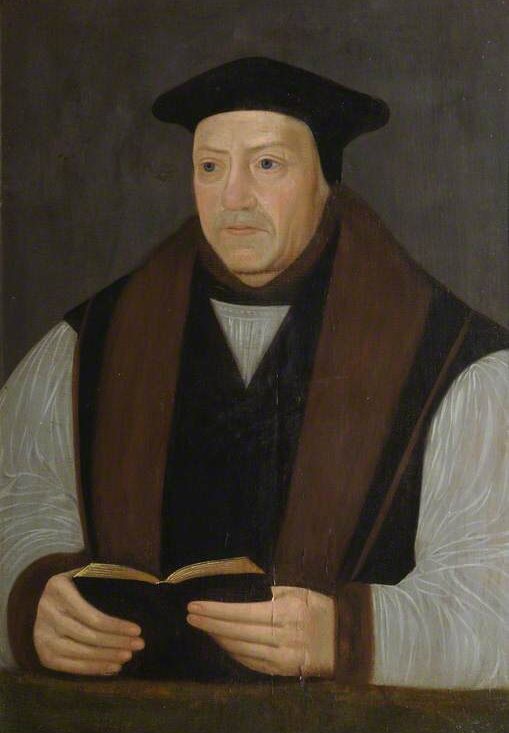
Today’s Leader of Faith
MATHEW PARKER
Home Call : 17 May 1575
Archbishop, Reformative Leader, Theologian, Translator, Author, Doctrinal Stabilizer, Patristic Scholar
Matthew Parker (1504–1575) was an English Archbishop of Canterbury, who played a significant role in the English Reformation, particularly in the establishment of the Church of England’s doctrines and liturgy. He was born on 6 August 1504 in Norwich, the eldest son of William and Alice Parker. His father was a wealthy worsted weaver. His father dies around 1516 and he grew up in Norwich and was educated by various clerics before attending Cambridge University in 1520. There, he became involved with reformist ideas, reading works by Martin Luther and supporting clerical marriage. He graduated in 1525 and was ordained a deacon and priest in 1527, later becoming a fellow at Corpus Christi College. Although he remained loyal to Thomas Bilney, a fellow reformer, Parker was not involved in public disputes at Cambridge. He was licensed to preach in 1533 and became a popular preacher.
Parker became Anne Boleyn’s chaplain and, through her influence, was appointed dean of Stoke-by-Clare in 1535. He revitalized the college by introducing new statutes, improving education, and establishing a grammar school. Before Anne Boleyn’s arrest in 1536, she entrusted her daughter Elizabeth to Parker’s care, a responsibility he honored for life. He earned his Doctor of Divinity in 1538 and became chaplain to Henry VIII. In 1541, he was appointed to the second prebend at Ely, signaling royal approval. In December 1544, Parker was elected master of Corpus Christi College, Cambridge, on Henry VIII’s recommendation. He improved the college’s finances, repaired buildings, and founded new scholarships, earning recognition as its second founder. In January 1545, he became vice-chancellor of the university. During Edward VI’s reign, Parker helped protect Cambridge’s colleges from dissolution under the 1545 Act, while Stoke College was dissolved. However, under Mary I, Parker was demoted, losing his deanery, master ship of Corpus Christi, and other positions due to his support for Northumberland and his marriage. Despite this, he survived Mary’s reign without fleeing. After Queen Elizabeth I took the throne, she appointed Parker as Archbishop of Canterbury.
Parker is renowned for his significant contributions to Christian theology, particularly in relation to the Protestant Reformation in England. His work in theology, liturgy, and biblical scholarship played a pivotal role during the Elizabethan era. He is best known for overseeing the publication of the Bishops’ Bible (1568), also known as the Matthew Parker Bible. This English translation aimed to counter the influence of the Geneva Bible and reflect the theology of the Church of England, reflecting Anglican theology. He also wrote De Antiquitate Ecclesiae Cantuariensis (1572), emphasizing the Church of Canterbury’s independence from Rome. Parker contributed to the revision of the Book of Common Prayer to align with the Elizabethan religious settlement and played a key role in promoting the Thirty-Nine Articles of Religion. He wrote theological works defending the Church of England’s Protestant identity and made significant scholarly contributions to early Christian texts, consolidating Protestantism in England.
Parker died on May 17, 1575, at the age of 70, in Lambeth Palace, London—the official residence of the Archbishop of Canterbury. Though he had served as archbishop for 16 years under Queen Elizabeth I, his later years were marked by physical weakness and increasing political and religious strain. He was buried at Lambeth Parish Church (St Mary-at-Lambeth), but his tomb was desecrated during the English Civil War. His body was later rediscovered in the 18th century and reburied.
Born on October 14, 1922, in Chandodu, Nellore District, Andhra Pradesh, to devout Christian parents Booduru Joseph and Leelavathi. His grandfather Jacob and grandmother Rachel were great prayerful people who named him Paul and prophesied that he would serve God like the apostle Paul. Thus, because of God’s election, he was twice saved from a poisonous snake bite and once from a severe fever during his childhood. Thus, the Lord saved him from many dangers. He was brought up in the fear of God, completed his education, and with passion towards music earned a degree in Carnatic music. He hoped to establish himself professionally in the film industry as playback singer. But the Lord did not let him stray from His plan, but established him so that the Lord Himself would be glorified through the talents of his servant.
Then, on August 29, 1945, he received the assurance of salvation and was baptized, believing that his sins had been washed away according to 1 John 1:9, 1 Peter 1:19, and Ephesians 2:18. In due time, God called him to full-time service, as recorded in Isaiah 41:8-13. He immediately obeyed, resigned from his job, and told his parents, who were overjoyed. But their happiness did not last long. Because, the Lord Himself told him that he should leave everything and go wherever the Lord led him from November 2, 1945. The day before, on the 1st, while Brother Bhakt Singh was going to Madras by train, brother Lazarus, the servant of God, took him to Gudur Railway Station and requested Bhakt Singh to pray for young B J Paul on the railway plat form. B P Paul was greatly strengthened by the prayers offered by the servant of God Brother Bhakt Singh and was overjoyed. B.J. Paul, responding to the call of service revealed by the Lord, left home on the 2nd without telling anyone, he left home with nothing but a Bible and sandals on his feet, without a single penny in his hand. As the Lord had directed, he had to set everything in order in advance, so he traveled from Gudur to meet his boss in Nellore and got his resignation accepted.
B.J. Paul set out on his missionary journeys with the determination to be led only in the path shown by the Lord, with complete faith, without asking anyone or anything. Details of his missionary journeys :
1. Nellore : On November 2, 1945, during a train journey, under the inspiration of the Lord, he sang the song “Charitham, Sucharitham sriyesuni jeevitham” holding the Bible. People approached him to give alms thinking he is begging by singing. He said, “I do not ask you anything, but I bring you good news of salvation.” This was his first gospel proclamation.
2. Vijayawada : Till November 5, 1945, Mr. John, who was introduced to him made arrangements to conduct open gospel meetings for 3 nights and invited him as the main speaker and singer. This was his first gospel ministry.
3. Rajahmundry : Gospel meetings were held for the salvation of souls until the first week of February 1946.
4. Kakinada : For a few days in February, he preached the gospel alone.
5. Vizag : For about four months till June 1946, he held gospel meetings under the leadership of Pastor Percy Lazarus and Pastor Kanta Rao. There, he prayed alone on the sea shore for 27 consecutive nights to strengthen himself through prayer.
6. Kharagpur : 3 days’ ministry. He was acquainted with Isaac Newton.
7. Calcutta : June 1946, one month introduced to George Stephenson, and held cottage meetings.
8. New Delhi : July 1946 he was introduced to Brother Abraham Joseph who was saved and later served for a long time in Kadapa. He was then serving in Army and he arranged meetings for 15 days in a military camp.
9. Srinagar : August 12, 1946, introduced to Chandra Pandit and prayed with him.
10. Pahalgam : He preached the gospel to Amarnath pilgrims along with K. Jacob, an acquaintance from his childhood.
11. Amarnath : Inspired by the life of Sadhu Sundar Singh, he spent 7 weeks in meditation on the peaceful mountain ranges of the Himalayas, beholding the glory of God and with Divine inspiration he composed 36 poems titled “Flower Bouquet”.
12. Anantnag : Preaching the gospel in meetings organized by Pandit Mohanlal.
13. Srinagar : January 1947, invited by C. A. Hitter, preached the gospel for a month. He stayed in Kashmir for a period of 6 months from August 1946 to January 1947.
14. Calcutta : George Stephenson, realizing his dedicated life, decided that the saffron robes of Sadhu Sundar Singh were the most suitable for him gifted two pairs of robes.
15. Gudur : February 1947 he returned to his parents and testified about the Lord’s wonderful work, His faithfulness, and the salvation of souls.
16. Madras : 1947, as part of the South India evangelistic journey, he first went to Jehovah-Shamma by the inspiration of the Lord and met brother Bhakth Singh. Although the brother did not like the saffron robes, he invited him and allowed him to stay there.
Brother gently told B J Paul ‘The most important virtue is to live faithfully to God, and traditional saintly attire is not required” On the advice of Bhakt Singh, he agreed and decided to remove his saffron robes. Brother Bhakt Singh gifted him two pairs of white dresses and two coats to wear. At that time, everyone was in a humble and needy condition, so All the fellow servants were happy because of the new clothes he was wearing, saying, “You are blessed.” On January 30, 1948, after Gandhi’s assassination, the country’s leaders, including some pastors, wrote in the daily newspapers – comparing Gandhiji to Lord Jesus Christ. He could not stand the comparison of Gandhi with Lord Jesus Christ on radio, in newspapers and even in churches: With a heavy heart tears rolling down from his eyes, he composed a gospel song called ” Premamrutha dharalu chindhina mana yesuku samamevaru?” This is the first song included by him in the Songs of Zion. Until 1950, the Lord used him in many places in Rayalaseema and Andhra regions, along with Bhakt Singh, in ministry, translation, and even composing and singing songs.
17. Hyderabad : He remained in Elim from 1950-1951, as a translator for many God’s Servants and continuing to participate in the ministry.
18. Rajahmundry, Kovvur : 1951-1952 Proclamation of the Gospel in East Godavari and West Godavari districts.
19. Visakhapatnam : As a results of his labour, the first Lord’s Day service was held in September 1952, with the Lord’s Table on the upper floor of Dr. Lazarus’ bungalow, about 18 people were baptized and many were added to the church. Later, they rented a house in Ramanagar and named it Mizpah and continued their worship Service.
20. Congregations served : 1953-1963.Machilipatnam, Kurnool, Guntur, Kothagudem, and Chirala.
21. He served independently in Rajahmundry from 1963 to 1974, and later resided in Chandodu village near Gudur from 1974 to 1979. During this period, from 1966 to 1979, he also travelled extensively across India as the Regional Coordinator for Dr. Billy Graham’s evangelistic team. By 1979, he returned to Hebron, Hyderabad.
22. Congregations served : He served in Tenali, Nandyal, Malakpet, Borabanda, Hebron – Hyderabad from 1979-2003. Till the end, he was also responsible for various ministries in churches and continued composing and writing of songs.
The holy marriage of Brother B. J. Paul was performed with Sister Varalakshmi, the eldest daughter of Brother Samson and Jeevamani, both natives of Hyderabad, on July 16, 1958, at Elim by Brother Bhakt Singh. She had already dedicated herself to the ministry and resigned from her job as soon as she got married. The Lord blessed them with a son, Prince Joseph, a daughter, Hannah Salome, three grandchildren, and two great-grandchildren. His children are greatly blessed and are fulfilling their responsibilities as well as the Lord’s service in a humble way. B.J. Paul, who tasted the Lord’s faithfulness at every step of his life, served the Lord faithfully until the end of his life with the same experience.
— John Michael, Rajahmundry